
Al Maktoum Airport and Real Estate: How the Planned 2032 Opening Will Change the Investment Landscape in Dubai
A year of testing, 150 million passengers in the first phase, and a metro line by 2031: how the new airport is changing the real estate market in southern Dubai, off-plan purchases, and the landscape for European investors.
Al Maktoum Airport, Dubai’s future main airport, will open its first phase in 2032, following at least one year of testing without passengers. For the real estate market in Dubai, the timeline is clear: the center of gravity for air traffic will shift 70 km south, and the neighborhoods around Dubai South, Expo City, and Jebel Ali will be directly affected.
If you’re considering investing in Dubai—and specifically buying off-plan in the southern part of the emirate—here’s what the November 17, 2026, announcement reveals and what it actually means for you.
Al Maktoum Airport: Details of the November 17, 2026, Announcement
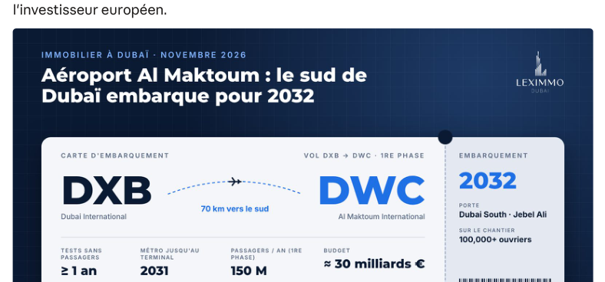
On November 17, 2026, Paul Griffiths, CEO of Dubai Airports, provided an update to the press on the construction of Al Maktoum International, also known as DWC (Dubai World Central). Here are the key figures.
First phase opening: 2032. The airport will operate for at least one year without passengers to test baggage handling, check-in, Wi-Fi, and other systems.
Capacity for the first phase: 150 million passengers per year. Ultimately, the plan calls for five runways, 260 million passengers, and 12 million metric tons of cargo per year.
Budget: approximately $35 billion, or nearly €30 billion (128 billion AED).
There are more than 100,000 workers on site. Piles are being driven, and earthwork is well underway.
Contracts: €3 billion (13 billion AED) in contracts already awarded for the new terminal, and approximately €12.8 billion (55 billion AED) announced in August to be awarded by the end of 2026.
The move will take place in stages. Dubai International (DXB) and Al Maktoum will initially operate in parallel, and then operations will be consolidated at the new site. According to Paul Griffiths, the project will be five to six times the scale of the Hong Kong airport relocation in the 1990s. He sums it up this way: it is “much more than just an airport project.”
Another idea being considered: city check-in kiosks. You could check your luggage at a subway station or at your hotel before heading to the airport. No timeline has been announced yet.
What the Calendar Reveals About the Real Estate Market in South Dubai
The first takeaway is that the project is moving forward. With more than 100,000 workers on site and contracts being signed one after another, Dubai Airports describes it as a “project that’s very much alive.” For an investor, this is the most important sign: real estate surrounding infrastructure begins to appreciate in value once construction becomes a reality.
Second, the transportation projects are following the same timeline. On November 10, 2026, Dubai announced the extension of the metro to the Al Maktoum West Terminal: 3 km, two new stations, approximately 465 million euros (2 billion AED), with service scheduled to begin in 2031. This extension continues Route 2020 of the Red Line, which already connects Jebel Ali to Expo City, and will link to Etihad Rail’s future high-speed train. The metro will therefore arrive about a year before the airport.
The third issue is housing. Paul Griffiths made it clear: employees who currently live in northern Dubai or in neighboring emirates will not be able to commute every day. New residential neighborhoods will be needed near the new airport. An airport handling 150 million passengers means tens of thousands of direct and indirect jobs: airlines, logistics, hospitality, retail, and services.
The areas most directly affected by real estate development around Al Maktoum Airport are:
Dubai South, the district built around the airport;
Expo City Dubai, the current terminus of the Red Line;
Jebel Ali, with major Nakheel projects such as Palm Jebel Ali and Palm Springs;
the neighborhoods already developed along the corridor, such as Dubai Investments Park, Al Furjan, and Jumeirah Golf Estates.
Finally, the announcement raises a question regarding the northern part of the city. The future of the DXB site will depend on a government decision. Paul Griffiths merely mentioned that, if the current airport were to close, the low-lying areas around it could accommodate taller buildings, which would drive up property values. At this stage, it’s just a possibility, not a decision.
Investing Near Al Maktoum Airport: What This Means for a European Investor
For investors from Belgium, France, Switzerland, or Luxembourg, the 2031–2032 timeline is ideal. A pre-construction purchase launched today in southern Dubai is typically delivered between 2028 and 2030. The property would therefore already be rented out by the time the metro—and then the airport—open.
In practical terms, this changes three things in your thinking.
- You’re buying a vision, not just a publicity stunt. The value of a property near Al Maktoum will increase in stages: completion of the neighborhood, the arrival of the metro in 2031, the opening of the airport in 2032, and then a gradual increase in traffic. This is a medium- to long-term investment.
- The demand for rental housing has a clear source. Future employees of the airport and its ecosystem will need to find housing near their workplace. This demand is employment-driven and more predictable than tourism-driven demand.
- The exact location matters more than the name of the neighborhood. In such a large area, a few kilometers can make all the difference. The distance to a future subway station, road access, and everyday amenities will make a difference in both rental and resale value.
When it comes to rental yields in Dubai, always consider both gross and net figures together. A gross yield listed in a brochure does not take into account condominium fees, rental management costs, and periods of vacancy. The net yield, on the other hand, tells you what you’d actually take home. In up-and-coming neighborhoods, rents could also rise as infrastructure is developed: this is a possibility, not a guarantee.
Things to Keep in Mind Before Buying in Southern Dubai
The timeline may change. 2031 for the subway and 2032 for the airport are official targets. Your investment plan must remain sound even if there’s a delay of a few months.
The transition will be gradual. DXB and Al Maktoum will initially operate in parallel. Traffic will not shift all at once in 2032.
A lot of new housing is coming to the south. It’s an area with major development projects. Choose a project that stands out: location, quality of construction, a reputable developer, and a payment plan that fits your budget.
Review the project before signing. Be sure to systematically verify the program’s registration with the DLD, the escrow account, the delivery schedule, and the developer’s track record.
Includes all costs. DLD registration fees, annual expenses, furnishings, and rental management fees all impact the net return.
A Word from the Tax Lawyer
In the UAE, individuals do not pay tax on rental income from their property. However, if you are a tax resident of Belgium, France, Switzerland, or Luxembourg, your country of residence has its own reporting rules. Each of these countries has signed a tax treaty with the UAE. The best approach is to have your situation reviewed before you buy, not after.
Invest near the future Dubai airport with Leximmo
Al Maktoum Airport is set to reshape Dubai’s real estate landscape. But you still need to choose the right neighborhood, the right development, and the right timing.
At Leximmo (RERA 62696), we work with more than 300 developers, including Emaar, Nakheel, Sobha, Ellington, Arada, and Meraas, and we select only projects that are sound. Our multidisciplinary team supports you every step of the way, from tax analysis to rental management.
Message us on WhatsApp at +971 52 214 3535 or visit leximmo-dubai.com to discuss this further.


