
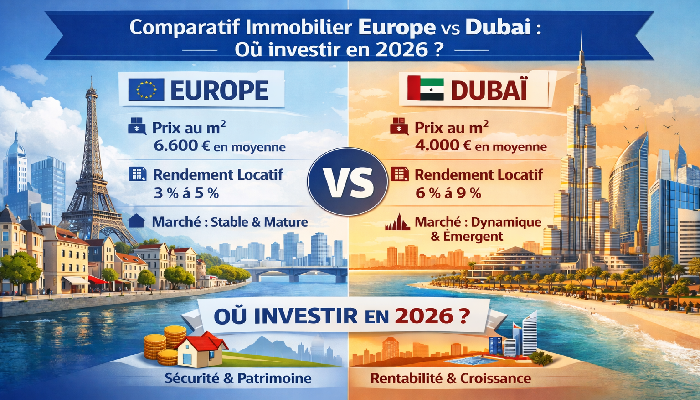

Europe vs. Dubai Real Estate Comparison: Where to Invest in 2026
Strategic analysis by Leximmo Dubai
Against a backdrop of economic and geopolitical uncertainty, European investors are increasingly questioning whether it makes sense to maintain their real estate investments in Europe or to turn to more dynamic international markets such as Dubai.
Within the firm Leximmo Dubai, we are seeing a clear shift in capital flows. Investors are no longer seeking solely asset protection, but also performance, liquidity, and tax optimization. In this context, Dubai is gradually emerging as a strategic alternative.
Rental yield: a significant difference
Rental yield is one of the key factors investors consider when making decisions.
In Dubai, gross rental yields generally range from 5% to 8%, with even higher returns in certain high-demand areas. This profitability is driven by steady population growth and strong rental demand, particularly from expatriates.
By comparison, major European capitals show significantly lower returns:
- Paris: between 2% and 3%
- London: between 3% and 4%
- Berlin: between 3% and 4%
This yield differential—often as much as double—is a key advantage for Dubai.
Taxation: A Key Driver of Performance
One of Dubai’s main advantages lies in its tax environment.
In the United Arab Emirates, investors enjoy the following benefits:
- the absence of tax on rental income
- the absence of capital gains tax on real estate
- the absence of a wealth tax
In contrast, in Europe, rental income is generally subject to a tax rate ranging from 20% to 45%, to which capital gains taxes and, in some cases, a wealth tax may be added.
Thus, a gross yield equivalent to that in Dubai translates into a net yield that is significantly higher than that observed in the Europe vs. Dubai real estate comparison.
Market dynamics: growth versus maturity
The Dubai real estate market is characterized by sustained growth.
In recent years, transaction volumes have reached record levels, driven by an influx of new residents, particularly those with high purchasing power. Every year, the city attracts thousands of international investors and high-net-worth individuals, boosting demand in the mid-range and high-end segments.
In contrast, European markets today are characterized by a certain degree of maturity:
- moderate price increases in several major cities
- rent control
- increased regulatory and environmental requirements
This difference in economic cycles places Dubai on a growth trajectory, while Europe is moving more toward a stabilization phase.
Market liquidity: a strategic factor
The liquidity of a real estate market—that is, the ability to buy and sell quickly—is a factor that is often underestimated.
Dubai benefits from high transaction volumes and strong international participation, which facilitates the resale of properties. The market is responsive, with properties turning over quickly, particularly in the most sought-after areas.
When comparing the real estate markets in Europe and Dubai, the time it takes to resell a property can be longer, particularly during periods of economic uncertainty or rising interest rates.
Security and stability: a reassuring environment
Despite regional geopolitical tensions, the United Arab Emirates continues to enjoy strong economic and political stability.
The country relies on:
- a diversified economy
- sound financial institutions
- a policy of openness to foreign investment
Dubai has established itself as a major international hub, attracting businesses, investors, and talent from around the world. This appeal helps sustain long-term demand for real estate.
Off-plan properties in Dubai versus European real estate
The Dubai market is characterized by a strong presence of off-plan sales, which account for a significant portion of transactions.
This model offers several advantages:
- installment payments during construction
- access at attractive prices
- potential for appreciation prior to delivery
In a comparison of real estate markets in Europe versus Dubai, real estate investment is primarily focused on existing properties, typically financed through traditional bank loans and offering more limited returns.
This structural difference reflects two distinct approaches:
Dubai as a dynamic investment market, Europe as a more conservative wealth management market.
Changes in investor profiles
In recent years, there has been a gradual shift of European investors toward Dubai.
This trend can be attributed to several factors:
- pursuit of profitability
- tax planning
- geographic diversification
- desire to safeguard one's assets in a stable environment
Dubai now attracts not only individual investors, but also entrepreneurs and wealthy individuals from around the world.
Conclusion: What’s the best choice for 2026?
The comparison of real estate markets in Europe versus Dubai highlights two distinct investment approaches.
Europe remains a traditional market, well-suited to a long-term preservation strategy with moderate risk but limited returns.
Dubai, on the other hand, stands out as a high-performance market, offering high returns, tax advantages, and strong liquidity.
Leximmo Dubai's Analysis
AtLeximmo Dubai, we assist European investors in structuring their investments in Dubai, using an approach based on rigor, transparency, and performance.
In a rapidly changing global environment, international diversification is no longer an option but a strategic necessity.
The question, then, is no longer whether to invest in Dubai, but how to do so wisely and safely.


