
Real Estate Near the Metro in Dubai: How the Plan for 48 Urban Centers Is Changing the Investment Landscape
Investing in Dubai near the metro: The emirate is investing more than €465 million to concentrate housing, jobs, and services around metro stations by 2040, with a target increase in real estate value of €4.65 billion.
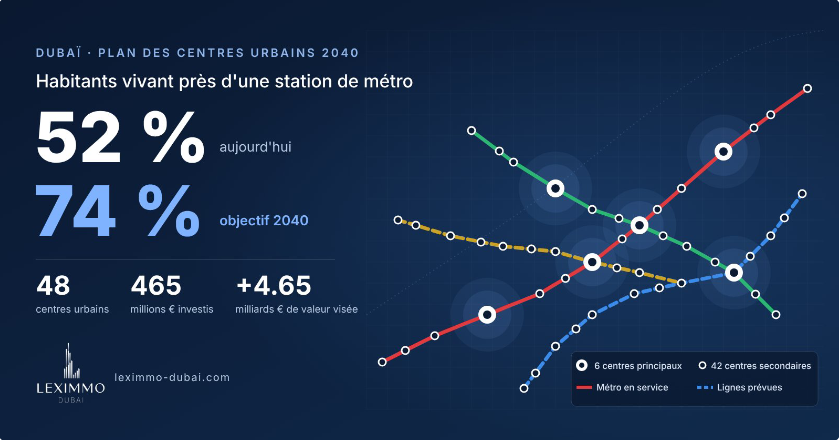
Real estate near the metro in Dubai is becoming an official priority for the emirate. Announced on October 27, 2026, the urban center development plan allocates more than €465 million (2 billion AED) to concentrate housing, jobs, and services around metro stations, with a target increase in real estate value of €4.65 billion (20 billion AED) in the targeted areas by 2040.
For those of you looking to invest in Dubai from Belgium, France, Switzerland, or Luxembourg, the message is simple: a property’s location relative to the transportation network will play an even greater role in determining its value. Here’s what the plan entails, what the numbers reveal, and how to take these factors into account before buying in Dubai.
A Detailed Map of Dubai's 48 Urban Centers
The plan was approved by the Dubai Executive Council, chaired by Crown Prince Sheikh Hamdan bin Mohammed. It covers 48 urban centers: 6 major centers and 42 secondary centers. Together, they account for 12% of the emirate’s urban area.
The principle consists of three ideas:
concentrate the population and jobs around public transit stations;
diversify land use by including housing, offices, retail, and services within the same neighborhoods;
to make the commute from home to work shorter.
The plan is based on three stated pillars: quality of life, economic returns, and infrastructure efficiency, including costs. The Higher Committee for Urban Planning and the Municipality of Dubai are overseeing its implementation.
On the same day, the Council also approved a demographic planning policy that links population projections to future needs for services and infrastructure. This is a logical extension of the Dubai 2040 Master Plan, unveiled in 2021, which had already identified five major hubs: Deira and Bur Dubai, Downtown and Business Bay, Dubai Marina and JBR, Expo City, and Dubai Silicon Oasis. The names of the six main centers in the new plan have not yet been released.
What the Plan's Figures Reveal About Dubai's Real Estate Market
The most telling figure concerns the subway. Today, 52% of residents live near a station. The goal is to increase that figure to 74% by 2040. In other words, the percentage of the population living near the subway system must increase by 22 percentage points in less than fifteen years.
Second goal: Access to public services (schools, healthcare, government offices, public spaces) must increase from 74% to 85%. For a tenant, this is what makes the difference between a neighborhood where you just sleep and one where you actually live.
Third benchmark: the ratio of public investment to expected value. More than 465 million euros (2 billion AED) in spending is projected to generate a 4.65 billion euro (20 billion AED) increase in real estate value in the areas concerned. The target ratio is approximately one to ten: public funds serve as leverage to boost the value of properties located around the stations.
This plan is in addition to the network expansions already announced, including the Blue Line, scheduled for 2029, and the Gold Line, scheduled for 2032. The new lines will bring new stations. The urban center plan outlines how the surrounding areas will be developed.
How This Affects Investing in Dubai from Europe
First effect: the walking distance to a station becomes a key selection criterion. An apartment just a few minutes from the subway appeals to a broad range of buyers: young professionals, couples, and executives who work in another neighborhood. It is this demand that
supports occupancy rates, and thus rental yields, in Dubai.
Second effect: mixed-use neighborhoods are becoming more attractive. A property located in a central area with offices, shops, schools, and services rents more easily than an isolated property. The plan is specifically designed to promote this trend.
Third point regarding off-plan purchases in Dubai: the map of future stations deserves just as much attention as the developer’s brochure. A project scheduled for completion in 2029 or 2030 near a Blue Line station, for example, would hit the market just as the infrastructure is set to begin operations. That’s when the value gap with a property that has poor transit access can widen.
In practical terms, before buying in Dubai, ask yourself these questions:
How many minutes is it on foot to the nearest station, whether it's already in operation or planned?
Does the neighborhood already combine housing, offices, and services, or is that planned for the future?
Is the project delivery date consistent with the completion of the infrastructure?
That’s exactly the kind of selection process we carry out at Leximmo from among the projects of more than 300 developers, including Emaar, Sobha, Ellington, Arada, Meraas, and Nakheel: we base our decisions on location and rental demand, not on marketing hype.
Things to Keep in Mind Before Buying Near the Metro in Dubai
The plan sets a direction, not a list of addresses. At this stage, the 48 centers have not been announced one by one, nor has a detailed schedule of the work been released. Be wary of any announcement that already presents a project as “located in an urban center included in the plan” without an official document to back it up.
The increase of 4.65 billion euros (20 billion AED) is a target for 2040, across all targeted areas. It says nothing about how the price of a specific apartment will change. As for returns, these must be calculated on a property-by-property basis—always on a hypothetical basis—both gross and net, that is, after deducting condominium fees, management fees, and vacancy periods.
Finally, “near the subway” isn’t enough. The quality of the building, the developer’s reputation, the payment plan, and the price per square meter relative to the neighborhood are just as important. A subway station can’t make up for a poor purchase price.
A Word from the Tax Lawyer
In the UAE, individuals do not pay tax on their rental income. However, if you’re a tax resident of Belgium, France, Switzerland, or Luxembourg, you must still report your property in Dubai in your home country, in accordance with that country’s own rules and the tax treaty it has signed with the UAE. These rules vary from country to country—which is why we analyze your situation before the purchase, not after.
Invest Near the Metro in Dubai with Leximmo
Want to know which projects—whether still in the planning stages or already completed—truly benefit from the transportation network and urban center layout? Leximmo (RERA 62696) helps you sort through, compare, and buy in Dubai with complete transparency.
Message us on WhatsApp at +971 52 214 3535 or visit leximmo-dubai.com.


