
Investing in the World Islands in Dubai: What the 4-billion-dirham project reveals
Off-plan purchases, luxury developments, floating villas, and yacht shuttle service: Dubai’s real estate market is heading back out to sea—and here’s how that changes the landscape for investing in Dubai from Europe.
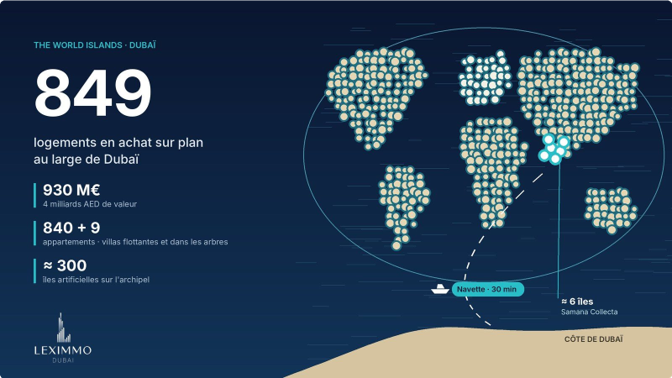
Investing in the World Islands in Dubai is once again a hot topic. On October 15, 2026, Samana Developers announced a project worth more than 930 million euros (4 billion AED) on the archipelago, with 849 homes sold off-plan and a yacht shuttle running every 30 minutes to the mainland.
This is a strong signal for the archipelago. For a European investor who follows the real estate market in Dubai, this is a signal to watch closely: what it signals, what it reveals about the market, and what needs to be verified before buying.
World Islands: A Detailed Look at the Samana Announcement
The project is the first development by Samana Collecta, the new luxury brand from Samana Developers. The developer claims to have launched 54 projects in Dubai.
The figures announced:
- a development value of more than €930 million (4 billion AED);
- approximately six islands acquired in 2025 within the archipelago;
- 840 apartments in a luxury residential complex, ranging from studios to four-bedroom units, all with ocean views;
- 7 floating villas and 2 “treehouses”;
- an Italian luxury brand partner, whose name will be revealed at a later date;
- For the premium segment, a target price of approximately 7,500 € (32,300 AED) per square meter.
In terms of daily life, the developer plans to include several beaches, a lagoon, swimming pools, a beach club, spas, gyms, coworking spaces, shops, and several restaurants. The stated goal: an island where people can live year-round, not just a weekend getaway.
Access will be provided by yacht shuttles departing for Dubai every 30 minutes. Boarding locations will be announced at a later date.
The timeline: a contractual commitment to deliver within four years from the start of construction, with an internal target of approximately 39 months. The project is financed primarily by payments from buyers, as is the case with most off-plan purchases in Dubai.
What This Project Reveals About the Real Estate Market in Dubai
The World Islands consist of approximately 300 artificial islands shaped like a map of the world, located a few kilometers off the coast. Nakheel launched the project in 2003. Land reclamation was largely complete by early 2008, but then the global financial crisis brought most of the construction projects to a halt.
Since then, development of the archipelago has proceeded in stages. The best-known project is “Heart of Europe,” by the Kleindienst Group, featuring luxury hotels and residences. A large portion of the islands remains undeveloped.
Samana's announcement reveals three things.
Scarce land is shifting toward the coast.
Along the coast, seaside lots are becoming scarce. The islands offer what the mainland lacks: guaranteed ocean views, privacy, and a distinctive location. This is the same concept behind Palm Jumeirah, Palm Jebel Ali, and Dubai Islands.
The developer also becomes the island's manager.
Samana serves as the lead developer. He oversees the electricity, water, wastewater, waste management, and maritime transportation systems. On an island, these infrastructure systems make all the difference between a livable project and a showcase project.
Luxury residential developments remain the driving force behind the high-end market.
An Italian luxury partner, a floating Italian restaurant with a Michelin-starred partner, and floating villas: the project is clearly aimed at a clientele that is buying an experience as much as a home. The CEO of Samana estimates that real estate on the islands could sell for 50 to 60 percent more than a traditional home in Dubai, while noting that nothing is guaranteed.
What This Means for a European Investor
For business owners or self-employed professionals in Belgium, France, Switzerland, or Luxembourg, this project opens up new opportunities in Dubai’s real estate market: life on an island—not just right on the waterfront.
A rare product on the market.
Homes on a private island, complete with a beach and on-site amenities, are still few and far between in Dubai. That is largely what makes Palm Jumeirah so appealing. The World Islands could follow a similar model if the island truly becomes a year-round residential community.
A long-term off-plan purchase.
With a target completion date of 39 months and a contractual commitment of four years after construction begins, this is an investment that will last for several years. This project is for those willing to wait, not for those seeking immediate returns.
A focus on property ownership rather than rental.
There is not yet a rental history for this type of residential island. Rental yields in Dubai—both gross and net—are calculated based on actual neighborhood data; in this case, we will have to wait for the first units to be delivered before we can quantify them. Seasonal rentals might be a viable option for this type of property, but there is no way to confirm this yet.
The Golden Visa is still an option.
Depending on the property's value, purchasing off-plan may qualify you for the Golden Visa in Dubai. Eligibility is determined on a case-by-case basis before the reservation is made.
A choice of unit that counts double.
On an island, the view, the orientation, and the distance to the beach and the shuttle dock determine resale value. It’s better to target the rarest units in the project rather than the most accessible ones.
Things to Keep in Mind Before Buying on The World Islands
A project on an island requires more checks than a building in the city. Here’s what we look at first:
- registering the project with the DLD and the RERA, and depositing your payments into the project's escrow account;
- The island's infrastructure—electricity, water, wastewater, and maritime transportation—relies on the developer here, not on an already-serviced neighborhood;
- Access: The yacht shuttle is scheduled to run every 30 minutes, but the boarding locations have not yet been announced;
- the timeline: distinguishes between the 39-month target and the four-year contractual commitment following the start of construction;
- the partner brand: its name has not yet been made public, and it will account for part of the project's value;
- Condominium fees: On an island with beaches, a lagoon, and shuttle services, these fees reduce the net return.
The 50–60% premium mentioned by the developer is a target, not a market figure. Consider the price per square meter compared to Palm Jumeirah, Dubai Islands, or Bluewaters, and think about what you’re willing to accept if it takes a while to resell.
A Word from the Tax Lawyer
In the UAE, individuals do not pay tax on rental income. However, if you remain a tax resident of Belgium, France, Switzerland, or Luxembourg, your property in Dubai must be reported in your home country, according to that country’s own rules. Each of these countries has a tax treaty with the UAE, and how these treaties apply depends on your specific situation. It’s always best to analyze this before you buy, not after.
Investing in Dubai with Leximmo
The World Islands, Palm Jumeirah, Dubai Islands, or an off-plan purchase in the city: at Leximmo, we work with over 300 developers—including Emaar, Sobha, Ellington, Arada, Meraas, and Nakheel—and we carefully curate our selection for you. Want to know if a waterfront project makes sense for your investment portfolio?
Message us on WhatsApp at +971 52 214 3535 or visit leximmo-dubai.com.


